Weekend food waste roundup – 21 October 2012

Jack-o-lanterns: a scary amount of food waste

Smart Suzy: Ready for pumpkin-carving? Cut down on food waste, go green, deals | Our Smart Money — In this entry, Smart Suzy talks about creative ways to carve pumpkins, and about food waste, but doesn’t link the two topics. So what will you be doing with all that pumpkin flesh to keep it out of landfill?

Easy listening

On The Point: GMOs, Food Waste, and Food as Entertainment | Slow Food Los Angeles — Interesting and thoughtful discussion, and a timely one for those in California who will be voting on prop 37.

Dumping food waste – ABC South Australia – Australian Broadcasting Corporation (ABC) — This audio program, with two Aussie Food Waste Experts, shares tips and recipes to help reduce waste and save money.

And in other news

Study Finds That Cutting Food Waste Could Feed One Billion Hungry People | Inhabitat – Sustainable Design Innovation, Eco Architecture, Green Building — In inhabitat (an online magazine that promotes sustainable design), Kristine Lofgren reports on a study that our current approach to feeding 9 billion people may be short-sighted. This study found that approaches that cut food waste, rather than increase food production, could feed 1 billion people.

Anger over waste scheme (From The Northern Echo) – Is Politically speaking, it is still hard to convince communities to embrace food waste solutions

Modern alchemists

Food waste is one raw material we have way too much of, and there are plenty of schemes to turn it into usable products.

30,000 TPA Food Waste to Biogas Facility for Edinburgh – Waste Mangagement World — Edinburgh plans to turn 30,000 tonnes of food waste in biogas each year

Waste could prove a money-spinner – Taipei Times — Entrepreneurs in Taiwan have developed new technologies to make the wasted sorghum grains into value-added products.

Starbucks turns food waste into plastic | Green Futures Magazine — Meanwhile, Starbucks is looking to turn food waste into plastic.

Composting in the Valley Cuts Down on Food Waste — Black Bear Composting is helping restaurants turn waste into compost for local farmers. I’m not sure this is helping reduce food waste, as the title claims, but it is a good way to divert it.

Composting—Turning Garbage into Black Gold – State of the Planet — Food waste is now collected at 25 GrowNYC Greenmarket locations and many other sites in New York City for composting.

Let Us Compost helps apartment dwellers, restaurants be more green | Online Athens — A new start-up that is providing a solution to help urban dwellers compost.

Lebanon news – NOW Lebanon -Food for thought on World Food Day — Two great causes that go great together: food recovery and composting.

Levi’s Launches New WasteEcouterre – OK, this one isn’t about food waste, but thought I’d throw it in here anyway…

222 million tons app mentions

4 Mobile Apps Helping Minimize Waste in the Food Industry | Sustainable Cities Collective — This article seems to be making the rounds.

Apps Only Apps » 222 Millones de toneladas …. — A Spanish app review site. My high school Spanish lies abandoned corner of my brain, but I remember enough to be happy with the words “222 Millon Tons es una brillante idea (creo yo)…”
Weekend food waste roundup – 14 October 2012

We didn’t see very much about food waste in the news this week, though it was great to see the 222 million tons app mentioned in one of the articles we found, as well as a call for action in Singapore (my home away from home much of the time).

I’ve also included links to a couple of blog posts in this week’s roundup, from two of my favourite bloggers who go the extra mile in the composting department.

In the news

Mobile Apps Can Help Reduce Food Waste

Eagles recycling extends to the parking lot

TODAYonline | Voices | Food is to be eaten, not dumped

Composting - going the extra mile

Stealing Trash – A New High « Dirt N Kids

Hair cuts = compost | Attempting zero waste lifestyle in a military household

Weekend food waste roundup – 7 October 2012

This week’s roundup has a tips on preserving food (including using etheylene absorbers to prolong the shelf life of produce) and reducing waste (including an article on reducing Thanksgiving waste – timely, if you happen to be Canadian), as well as a couple of articles about the issue of food waste.

Tips for preserving food and reducing waste

How to Absorb Ethylene Gas | eHow.com

Budget Tip: How To Vacuum Seal Food Without a Vacuum Sealing Machine | The Kitchn

Save Your Food: Canning and Freezing 101 – Earth911.com

Cooked Apple Recipes Great for Fall, Baked Apples, Apple Crisp and More – AARP

7 ways to reduce household food waste –  News – MSN CA

Tips from the pros on cutting Thanksgiving waste – The Globe and Mail

More on food waste

UN Says Europe Wastes 50% Of Fruit And Vegetables — And America Isn’t Much Better – Forbes

Radio Prague – Study maps makeup of Czech household waste

Weekend food waste roundup – 30 September 2012

It seems that food waste is getting a bit more attention these days, and so I’ve decided to share information on Twitter and Facebook as I come across it, with the occasional round-up here. Some recent finds follow…

Consumers want it. Now is the time to act on food waste | Comment & Opinion | The Grocer – It’s nice to see that there’s some dialogue about food waste in the grocery industry.

Grocery Chain Figures Out How to Stop Wasting Food | Care2 Causes – If you make money selling food, it makes good business sense not to waste it. Stop & Shop has bucked traditional supermarket wisdom and made that discovery.

From Farm to Landfill – NYTimes.com – As we struggle to find ways to grow more and more food to feed more and more people, one obvious way to increase the food supply is often overlooked: waste less.

Chuck Newcomb: Avoid wasting food by buying what’s needed, storing it properly – A little common sense advice on how not to waste food.

Refreshing, but fatal

This blog entry is a eulogy – and like all good eulogies, it starts with a poem.

     Gone after twenty years,
     With one soft and fatal gasp.
     My kitchen partner, who knew no fears…
     Gone! After twenty years.
     A void, and yet there are no tears,
     And to my neck I raise no asp.
     Gone. After twenty years.
     With one soft and fatal gasp.
.

What words can I use to describe my long time kitchen companion? Reliable? Tireless? Efficient? All of those, and more. Yet, now that I think of it, undeniably more sluggish lately; struggling to do what had once been so easy … so effortless.

Now those struggles are over, and my kitchen helper is still and lifeless. And, here, my confession: it was all my fault. I alone am to blame. Dessert was my idea, and it was the dessert that was fatal.

Mea cupla.

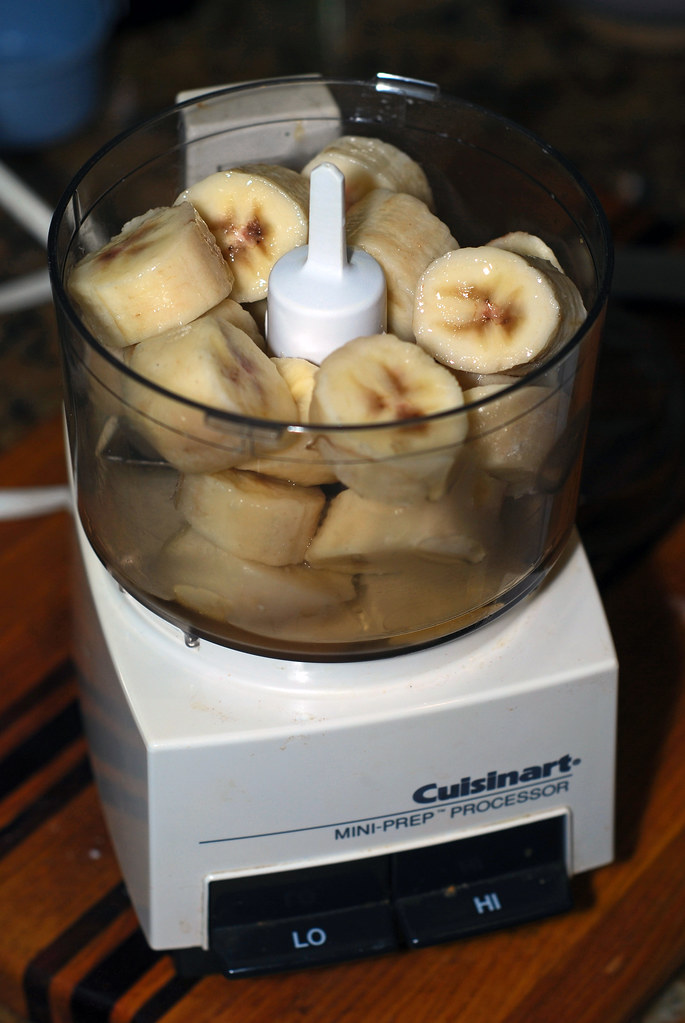
The recently departed, dear, little three cup Cuisinart was a wedding gift, and over the years it made falafel with us, velvety soups, dips, salsas … too many things to list. It wasn’t the biggest Cuisinart in the world, or the fanciest, but it was always there.

Reliable. Tireless. Efficient.

Easy to clean.

It was killed by two frozen bananas, which have become staples around here. An early commenter on 222 million tons shared this tip, “Sometimes I wait too long for my bananas to get that perfect balance of yellow and brown, so I freeze peeled bananas and then use it later for milkshakes! No need to add ice-cream or sugar to make it slushy or sweet.” It was wisdom we incorporated into our lives, to the detriment of our trusty little appliance. Mami, if you read this blog still, know that you have blood on your hands too. Cuisinart blood.

The silver lining on all this is that our marriage has outlived yet another wedding gift; another milestone has been crossed. We now know that our love is stronger than a three cup Cuisinart, romantic words that may well end up on the family tombstone – a lyrical epitaph indeed.

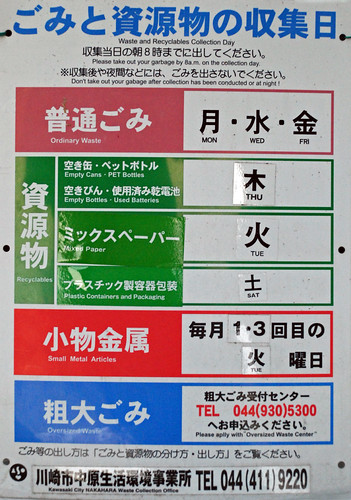
Garbage ulesAnd now to practicalities. We will need to dispose of the body; of the sad, tiny Cuisinart corpse. In Japan, that would have been easy. There was a shop that bought old appliances that could be salvaged for parts, and if they didn’t take it, the prominent poster over our garbage bin had information to steer us right. Here we’ll have to do a little research. And of course, although it’s a little soon to talk of such things, we will need a replacement – and if any of you have tips in that department, please share them in the comments. It may sound disrespectful, but we were ready for an upgrade anyway.

As a final act of remembrance, I feel I should share the recipe that killed the Cusinart. Usually, people refer to this treat as “one ingredient ice cream”, but in our home it has another name this week.

One appliance ice cream (serves 2)

One ingredient ice cream

Ingredients

  • Two frozen bananas
  • One Cuisinart

Directions

  • Remove bananas from freezer.
  • Slice finely with a heavy knife.
  • Place slices in Cuisinart and let sit for a few minutes, to give them time to soften (especially important if your Cuisinart is on it’s last legs).
  • Pulse on high until the bananas have the consistency of soft serve ice cream, or until smoke comes out of your Cuisinart.

This simple dessert is rich, refreshing, loaded with potassium, made with no animal products, and potentially fatal.

The last picture of it before it died.

The last picture of my kitchen helper before it passed on. RIP, little friend.

Seitanic bites?

I like meat.

Bonnie Lee likes meat.

Despite that, meat has never been a big part of our diet, and it’s not something we cook with at home very often.

We made that choice very consciously when we were first married based on simple arithmetic: it takes more land, water and sunshine to make a pound of meat than a pound of vegetables — and there is only so much water, sunshine and land to go around. Given that, and the fact that there are people who go to bed hungry, a meat-rich diet always felt like taking more than our fair share. It always felt selfish and wasteful.

Having been raised in traditional North American households, though, we both grew up with meat at the centre of our diets, and enjoy meat’s bite and texture, not to mention that burst of umami. When a meal calls for that, we often use seitan.

There are many varieties of commercial seitan, and most are very tasty, but if you’d rather opt out of the additives, packaging and transportation that come with processed food, you’ll be pleased to note that it’s easy to make at home. We made our fist batch this weekend, and it was better than any packaged seitan I’ve ever tried. It was flavourful on it’s own – even better after sitting in a chipotle marinade – and had a great mouthfeel. We used it to make tacos, which we served with a fresh homemade salsa and cilantro rice. I’m currently working on a vegetarian collection for the 222 million tons app, and this recipe definitely made the cut.

Seitan tacos

Seitan tacos

Seitan (six servings)

Ingredients

Seitan
Broth
  • 4 cups stone soup or other broth
  • 4 cups water
  • 2 Tbsp tamari sauce
  • ½ inch ginger
  • 1 thick slice of onion
  • 1 clove garlic

Directions

  • Warm 4¾ cups of stone soup broth over medium heat.
  • Remove ¾ cups of the broth to make the seitan. Add in the tamari, lemon juice and crushed garlic.
  • Put the flour in a bowl, pour in the spiced broth, and mix.
  • Take the elastic glob that forms out of the bowl, squeeze out any excess liquid, and knead it for 2 or 3 minutes until it gets tough.
  • Shape it into a loaf, and let it rest for 15 minutes.
  • While the seitan is resting, add the water, tamari sauce, ginger, onion and garlic to the remaining broth and bring to a low boil.
  • Cut the seitan loaf into ¼ inch slices, then boil those in the broth for about an hour.
Seitan cutlets

Seitan cutlets

222 million tons: the App

The idea behind 222 million tons has always been to spark conversation and change – and to do that by sharing tips, tools, and resources that help people waste less food and eat well. So far, that’s only been through this blog, but as of last week, we have an iPad App in iTunes.

The App is a publishing platform for weekly menus and shopping lists. The recipes all work for a single person (though through the miracle of technology, they can be scaled), and use up all the fresh ingredients on the shopping lists.

The idea was Bonnie Lee’s, and emerged out of her frustration over the amount of food she was wasting when she first moved from Tokyo to Los Angeles. She was overwhelmed by the quantities that food was sold in, and had no idea how a single person could use it all before it spoiled. In Japan, there are home economics magazines that help people save money by providing weekly shopping lists and recipes, but she couldn’t find anything like that in L.A. – and all the recipes she could find served 6 to 12 people. Bonnie Lee doesn’t like leftovers … so she issued me a challenge, which led to this App, built by our friends & partners at bluejava: Glenn & Makiko.

The first collection of recipes is called Bright & Bold, and was written by me (more on that another day), but my hope is that the 222 millions tons App will become a platform on which a large community of home cooks shares recipes – and if anyone reading this is interested in becoming part of that community, let me know via the comments below, or through any of the community platforms listed on my Gravatar profile.

The key to reducing food waste at home is planning – and as I wrote Bright & Bold, I came to appreciate the challenge of planning whole weeks for a single person with both variety and zero waste. So, if you don’t have time to plan meals, but hate waste and like to eat well … well, now there’s an App that can help.

Watermelon rind is food too

Watermelon rind has it tough. It lives next to sweet, pink, refreshing fruit that can be eaten as is, or easily become the base of colorful drinks, salsas, granitas and soups. How many of us even acknowledge rind as food? How many of us stop eating when we reach the unsexy, white, flavorless stuff? How many rinds end their lives needlessly in landfill?

Too many to contemplate.

But watermelon rind is food too, and there’s no reason to throw it away, or even compost anything but the hard, dark green skin (less than a millimeter thick). Although the rind is not as flavorful as the rest of the fruit, it is slightly sweet and has a firm, crisp texture that holds up well to cooking. It can be incorporated into the aforementioned drinks, salsas, granitas and soups — but also does well on it’s own in both sweet and savory concoctions.

Watermelon rind chutney

Take that, sexy, pink, attention-grabbing watermelon flesh

I’ve been in the mood for Indian food lately, so when I found myself with 10 cups of watermelon rind earlier this week (harvested from a 7 pound watermelon), I decided to use it to make chutney. The recipe is below, and the result is a spicy, sweet, sour, aromatic condiment that makes a perfect accompaniment to Indian food, meat dishes or strong cheeses.

Watermelon Rind Chutney

Ingredients

Cubed watermelon rind

Cubed watermelon rind

  • 10 cups watermelon rind, diced in ¾ inch cubes with dark green skin removed
  • 2 cups raisins
  • 2 serrano peppers with seeds, minced
  • ½ cup ginger, skinned and coarsely chopped
  • 1½ Tbsp garlic, coarsely chopped
  • 1 tsp red pepper
  • ¾ tsp cinnamon powder
  • 
½ tsp cardamom
  • ½ tsp ginger powder
  • ¼ tsp powdered cloves
  • 1 tsp salt
  • 2 cups cider vinegar
  • ¼ cup lime juice
  • 1½ cups sugar

Directions

  • Place watermelon rind, raisins, serrano peppers, ginger, garlic, red pepper, cinnamon powder, cardamom, ginger powder, powdered cloves, salt and half of the vinegar in a large pot.
  • Add enough water to just cover the fruit, and give everything a good stir.
  • Bring the liquid to a boil, then immediately reduce heat to low.
  • Cook on low heat for 1 hour, stirring occasionally, until the rinds take on a translucent quality.
  • Add in the rest of the vinegar, the lime juice and the sugar, and stir until sugar dissolves.
  • Bring the liquid to a gentle boil, and, stirring frequently, continue to boil until the liquid has the consistency of jam.
  • Put the chutney in a sterilized jar.

This chutney will stay fresh for several months in the refrigerator.

Fun facts
Reduction in food waste per batch of chutney 10 cups
… and if every household in the US makes 1 batch Over 9.6 million cubic feet
Volume of the Washington Monument About 1 million cubic feet

222 million tons

222 million tons — according to a 2011 UN study, that’s how much food consumers and retailers in industrialized nations waste every year, mostly by throwing away perfectly edible food. Just to put that number in perspective: it’s almost equivalent to the net food production in sub-Saharan Africa, and area about two and a half times the size of the United States.

It’s huge.

If you’re the average North American or European consumer, you throw away between 210 and 250 pounds of food each year (if you want to picture that better, 250 pounds is the weight of 1000 Quarter Pounder™ meat patties before they’re cooked — or the weight of over 1300 cooked patties). If you’re the average North American or European consumer, you can do better.

Our neighbors in sub-Saharan Africa, South Asia and South-East Asia waste less than 10% as much as we do, throwing away an average of 13 to 24 pounds of food a year. That seems like a good target. And helping people reach that target is what this blog, and the 222 Million Ton project, are all about.

In this blog, we will share tips and tools that can help people adopt more sustainable practices, and hopefully spark conversations that will lead us in directions that we haven’t anticipated, and that our team and our readers can learn from.