Unknown's avatar

About Jean-François

Jean-François Chénier is a product and media consultant. He is a founder of Pyxédo Publishing, EcoGames.net, and the 222 million tons food waste project.

Refreshing, but fatal

This blog entry is a eulogy – and like all good eulogies, it starts with a poem.

     Gone after twenty years,
     With one soft and fatal gasp.
     My kitchen partner, who knew no fears…
     Gone! After twenty years.
     A void, and yet there are no tears,
     And to my neck I raise no asp.
     Gone. After twenty years.
     With one soft and fatal gasp.
.

What words can I use to describe my long time kitchen companion? Reliable? Tireless? Efficient? All of those, and more. Yet, now that I think of it, undeniably more sluggish lately; struggling to do what had once been so easy … so effortless.

Now those struggles are over, and my kitchen helper is still and lifeless. And, here, my confession: it was all my fault. I alone am to blame. Dessert was my idea, and it was the dessert that was fatal.

Mea cupla.

The recently departed, dear, little three cup Cuisinart was a wedding gift, and over the years it made falafel with us, velvety soups, dips, salsas … too many things to list. It wasn’t the biggest Cuisinart in the world, or the fanciest, but it was always there.

Reliable. Tireless. Efficient.

Easy to clean.

It was killed by two frozen bananas, which have become staples around here. An early commenter on 222 million tons shared this tip, “Sometimes I wait too long for my bananas to get that perfect balance of yellow and brown, so I freeze peeled bananas and then use it later for milkshakes! No need to add ice-cream or sugar to make it slushy or sweet.” It was wisdom we incorporated into our lives, to the detriment of our trusty little appliance. Mami, if you read this blog still, know that you have blood on your hands too. Cuisinart blood.

The silver lining on all this is that our marriage has outlived yet another wedding gift; another milestone has been crossed. We now know that our love is stronger than a three cup Cuisinart, romantic words that may well end up on the family tombstone – a lyrical epitaph indeed.
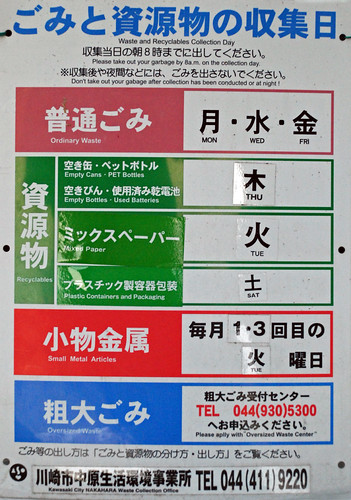
Garbage ulesAnd now to practicalities. We will need to dispose of the body; of the sad, tiny Cuisinart corpse. In Japan, that would have been easy. There was a shop that bought old appliances that could be salvaged for parts, and if they didn’t take it, the prominent poster over our garbage bin had information to steer us right. Here we’ll have to do a little research. And of course, although it’s a little soon to talk of such things, we will need a replacement – and if any of you have tips in that department, please share them in the comments. It may sound disrespectful, but we were ready for an upgrade anyway.

As a final act of remembrance, I feel I should share the recipe that killed the Cusinart. Usually, people refer to this treat as “one ingredient ice cream”, but in our home it has another name this week.

One appliance ice cream (serves 2)

One ingredient ice cream

Ingredients

  • Two frozen bananas
  • One Cuisinart

Directions

  • Remove bananas from freezer.
  • Slice finely with a heavy knife.
  • Place slices in Cuisinart and let sit for a few minutes, to give them time to soften (especially important if your Cuisinart is on it’s last legs).
  • Pulse on high until the bananas have the consistency of soft serve ice cream, or until smoke comes out of your Cuisinart.

This simple dessert is rich, refreshing, loaded with potassium, made with no animal products, and potentially fatal.
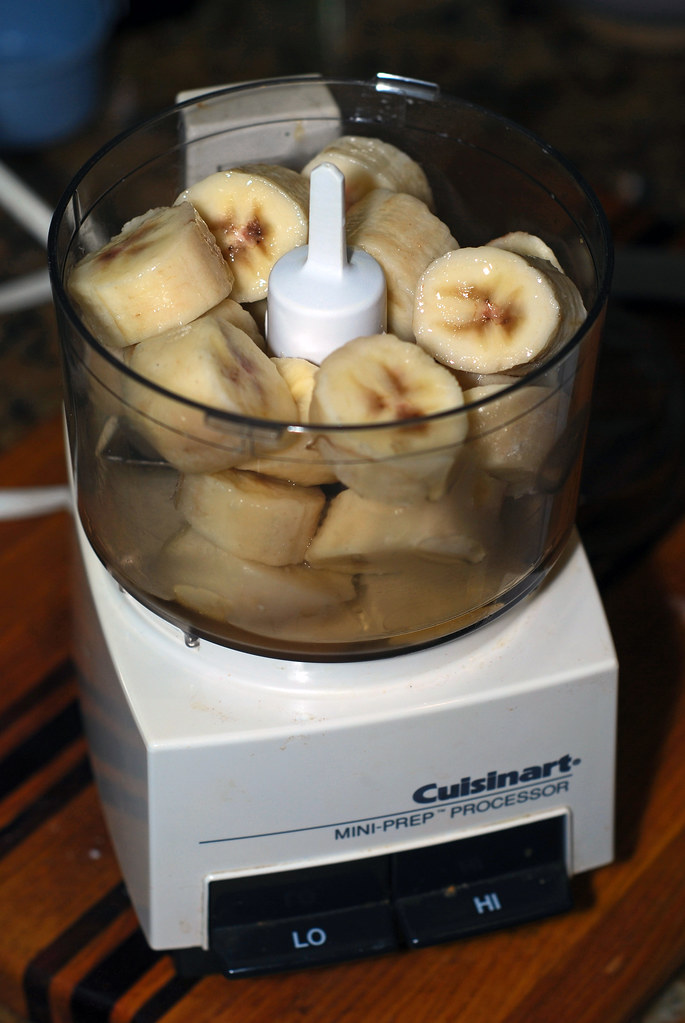
The last picture of it before it died.

The last picture of my kitchen helper before it passed on. RIP, little friend.

Seitanic bites?

I like meat.

Bonnie Lee likes meat.

Despite that, meat has never been a big part of our diet, and it’s not something we cook with at home very often.

We made that choice very consciously when we were first married based on simple arithmetic: it takes more land, water and sunshine to make a pound of meat than a pound of vegetables — and there is only so much water, sunshine and land to go around. Given that, and the fact that there are people who go to bed hungry, a meat-rich diet always felt like taking more than our fair share. It always felt selfish and wasteful.

Having been raised in traditional North American households, though, we both grew up with meat at the centre of our diets, and enjoy meat’s bite and texture, not to mention that burst of umami. When a meal calls for that, we often use seitan.

There are many varieties of commercial seitan, and most are very tasty, but if you’d rather opt out of the additives, packaging and transportation that come with processed food, you’ll be pleased to note that it’s easy to make at home. We made our fist batch this weekend, and it was better than any packaged seitan I’ve ever tried. It was flavourful on it’s own – even better after sitting in a chipotle marinade – and had a great mouthfeel. We used it to make tacos, which we served with a fresh homemade salsa and cilantro rice. I’m currently working on a vegetarian collection for the 222 million tons app, and this recipe definitely made the cut.

Seitan tacos

Seitan tacos

Seitan (six servings)

Ingredients

Seitan
Broth
  • 4 cups stone soup or other broth
  • 4 cups water
  • 2 Tbsp tamari sauce
  • ½ inch ginger
  • 1 thick slice of onion
  • 1 clove garlic

Directions

  • Warm 4¾ cups of stone soup broth over medium heat.
  • Remove ¾ cups of the broth to make the seitan. Add in the tamari, lemon juice and crushed garlic.
  • Put the flour in a bowl, pour in the spiced broth, and mix.
  • Take the elastic glob that forms out of the bowl, squeeze out any excess liquid, and knead it for 2 or 3 minutes until it gets tough.
  • Shape it into a loaf, and let it rest for 15 minutes.
  • While the seitan is resting, add the water, tamari sauce, ginger, onion and garlic to the remaining broth and bring to a low boil.
  • Cut the seitan loaf into ¼ inch slices, then boil those in the broth for about an hour.
Seitan cutlets

Seitan cutlets

Thai pickled cherry tofu anyone?

When I got back from my last trip, one of the first things I did was try some of the Thai pickled cherries we made in July, and I wasn’t disappointed. The flavours are complex and interesting, and blend perfectly. The first thing that hits the tongue when you have one is the lemon grass, but that’s quickly followed by a strong cherry taste with a hint of hot spice, and the finish is pure lime. There’s something strangely satisfying about them, and they add an interesting accent to plate of (strong) cheese & crudités.

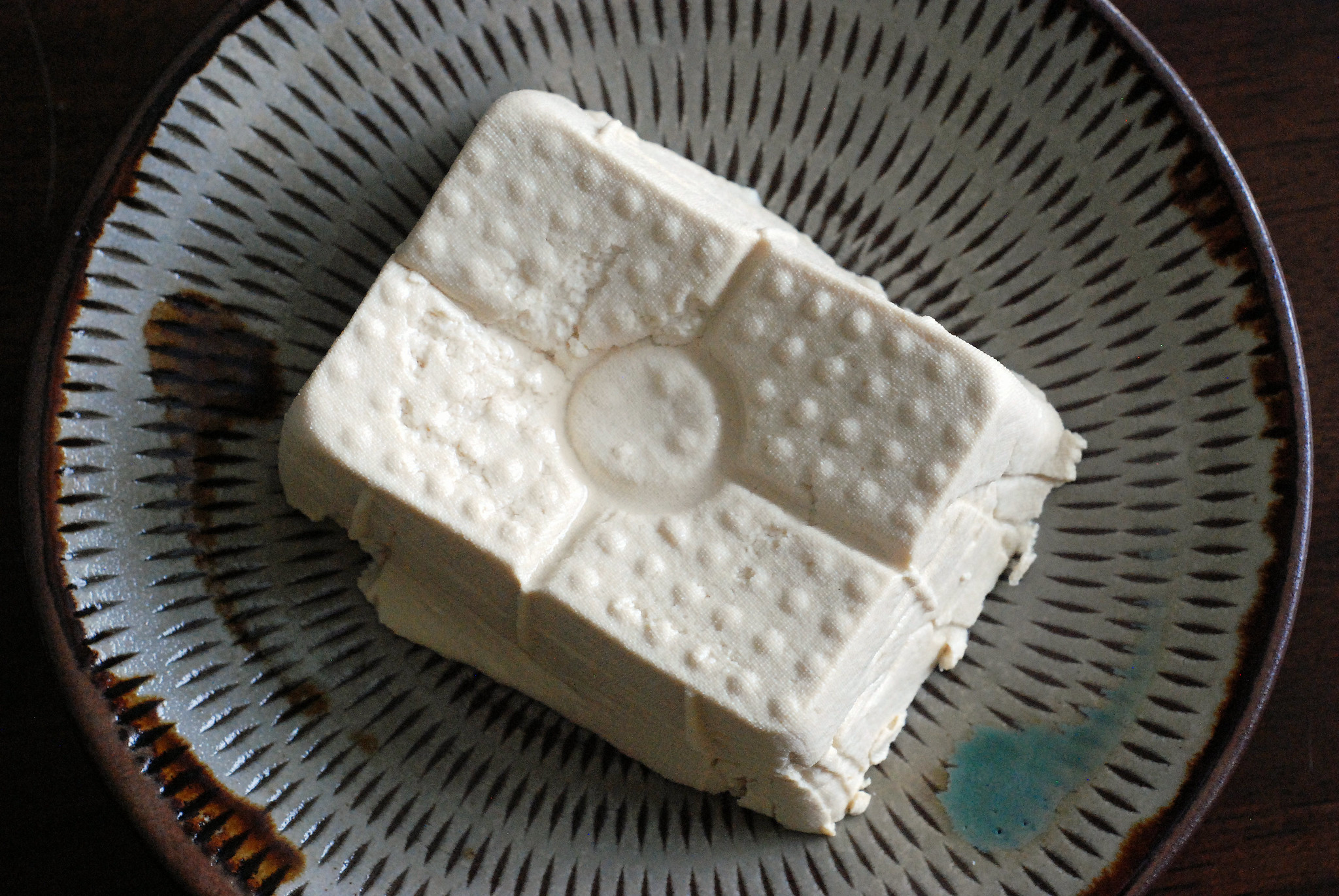
We’ve been making our tofu with nigari, the traditional Japanese coagulant, but wanted to try something a bit different, so decided to make a batch of firm tofu using the brine from the pickled cherries – just to see what would happen.

For the uninitiated, making firm tofu is straightforward; all you have to do is:

  • Slowly add your coagulant to hot soy milk until curds begin to form. If you made the soy milk yourself, remember to strain it through a cheesecloth first in order to remove the pulp, otherwise you will make very gritty tofu.
  • Let the mixture sit for 15 minutes.
  • Scoop the curds into a tofu mold lined with cheesecloth (or just pour everything in there). Tofu molds have holes that allow any liquid to run out, so you’ll want to put the mold in the sink first.
  • Once most of the liquid has drained out of the curds, fold the cheesecloth over so that the tofu is completely wrapped.
  • Put the lid on the mold and give the tofu a good squeeze over the sink.
  • Put the tofu mold in a dish (to catch any water that comes out as you press the tofu).
  • Put a weight on the lid, and let it sit for two hours.
  • If you’re not going to use the tofu right away, submerge it in water and put it in the fridge.
Fresh tofu

Fresh off the presses

We used about a quart of soy milk fresh from the soy milk maker, and it took 5 tablespoons of brine to make it coagulate. That made about 8 oz of firm tofu.

Using vinegar resulted in a somewhat less creamy texture than nigari does, and there was only the slightest a hint of all those great Thai cherry pickle flavours from the brine. Conclusion: there doesn’t seem to be much point in using a complex vinegar, but vinegar does give a good result. Even if you can’t find nigari, you can still make better-than-supermarket tofu at home using vinegar. The planet will benefit from your efforts by having a little less plastic in its landfills, and a little less CO2 in its air – and one thing’s for certain: if you take the time to make your tofu from scratch, you won’t be throwing it away.

Tofu frying

Tofu in wok

We used this particular batch of tofu to make Pad Thai, which we served with a few pickled cherries on the side. We used seitan instead of shrimp, though the meal wasn’t 100% vegetarian thanks to a couple of tablespoons of fish sauce.

Pad Thai with pickled cherries

Pad Thai with spicy pickled cherries

222 million tons in LA Times

Yesterday this URL got more than its usual amount of exercise thanks to an article in the LA Times: New app builds on efforts to reduce food waste. Most food waste articles focus on the magnitude of the problem, so it was particularly nice to be featured in a piece that was looking at what people are doing to make things better, including some who are already making a huge difference like EcoScraps and Food Cowboy.

It was my first interview, so I didn’t quite say everything I wanted to say the way I wanted to say it, but hopefully I’ll get other opportunities to bring attention to the food waste issue and things we can all do to make a difference.

Past and future tofu

I fell in love with the neighbourhood my first night there. I was in the new apartment, which was empty except for the blanket I was sitting on and a small lamp. It was early evening; I had settled down with a good book.

Bonnie Lee was still in our old place in Fukuoka, and I expected to have a quiet evening at home … but then the music started. It was traditional Japanese music, played on wood instruments, and drums, and it was coming from somewhere nearby.

Kosugi shrine

Kosugi shrine

And so I left the apartment, and followed the sound to our local shrine, which was teeming with people and activity. Food stalls lined the edges of the main open area, and in its centre, women clad in summer kimono danced the bon odori around a wooden scaffolding. As I worked my way through the crowd, I felt like I’d been dropped into the middle of a Bond film, minus the two guys chasing me.

Bon odori

Bon odori

It was a good place … and one that we would stay in for 10 years, the longest either of us has lived anywhere. The apartment was next to a park, which itself was next to a river. The city museum was a short walk away, as was the little centre around Shinmaruko station, with its restaurants and shops. It wasn’t long before we discovered the local tofu shop, which made fresh batches of all it’s products every morning, and only stayed open until the day’s stock was sold out. Everything they made was fresh and rich and somehow decadent … and all that soy-based goodness spoiled us for lesser goods.

Like the stuff we get in LA.

So, after more than a year of eating stale, somewhat bean-y tofu and soy milk, we decided to take matters into our own hands, and get ourselves a soy milk maker and some soy beans. I doubt that we’ll ever make anything that comes close to what we got at our little shop in Shinmaruko, but it is bound to be fresher than what we can get locally – and there are other reasons why this makes sense. One critical one is very dear to my heart: it will lead to less waste. We can make what we need when we need it – and the soy products we make will not need to be packaged in plastic or transported.

The day after I got back from my most recent trip, Bonnie Lee showed me how to make soy milk – nothing could be easier. You just need to soak the beans overnight, pop them in the soy milk maker with some water, push a button, wait while the machine heats the water and grinds and seeps the beans, then filter the product through cheese cloth. You can drink the milk as is, or add a coagulant and make tofu with it. And there’s a free bonus in every batch: the pulp that you filter out with the cheese cloth (called okara) is edible and versatile.

The soy milk we’ve been making is much lighter and more refreshing than the store-bought variety (which is thicker and often sweetened). It’s been very nice over our  home-made granola, and makes a great smoothie. As for the tofu and okara – I’ll save talking about what we’ve been doing with those for other posts.

In the meantime, if you’re curious you check out some of my shots of the old neighbourhood on flickr.

Self-sufficiency in Surbiton

1975 was the year the Jefferson’s moved on up, the year Baretta and (more significantly for me) his parrot found their way onto the airwaves, the year that Anne Romano moved to Indianapolis with her two daughters, and the year that we saw a horrifying vision of what space uniforms might look like in Space 1999. At the time, I’m pretty sure I could have told you when each of those shows was on the air – and, I went out of my way to be staring at my TV set whenever they were.

Somehow, these stories seemed important.

A mere four decades (or so) later, somehow they don’t. I don’t even think I could muster the curiosity to watch a whole episode of any one of them. But there is one series that started airing in 1975 that I find myself watching every couple of years: The Good Life (which, if you’re from the US, and watched PBS, you might know as Good Neighbors).

The Good LifeIt was a charming, witty show about a couple that decides to opt out of the rat race, and become self-sufficient. The series follows them as they turn their home in a residential neighbourhood into a small farm, much to the dismay of their dear friends and neighbours. There are no special effects, no impossibly beautiful people, no murders, no perfect NY apartments, no space ships, and no parrots … but there are pigs and chickens, not to mention great chemistry between the characters.

More significantly, almost 40 years later, the show seems even more relevant than it was then – and Tom & Barbara’s determination, passion and values are worth emulating (not something that can be said of many TV couples).

If you’ve never seen The Good Life before, there are far worse things to spend money on on Amazon. The scene below is from the first episode…

Supermarket periphery cereal

I’ve always been a big fan of cereal – and as a kid, there was no cereal I liked better than Cap’n Crunch’s Crunch Berries™. Now don’t get me wrong; I’m not talking about these newfangled GMO blue, green and purple crunch berries. I’m talking about the original red ones – the ones that grow on crunch berry trees, and are coveted by the likes of the infamous Jean LaFoote – natural crunch berries, that grow wild. Man I loved those berries … the way they stained the milk pink … the way they kind of cut the roof of my mouth.

The great tragedy for us Canadian kids was that crunch berries were only available for a brief period – just long enough for us to fall in love with their subtle charms. Then they simply disappeared. It was a dark time.

We kids knew they still existed just south of the border, as we could see ads for the cereal on US channels, taunting us through a translucent veneer of white noise. But, for whatever reason – perhaps an embargo on the import of tropical fruit – they couldn’t cross the 49th parallel.

Fortunately, I had family in Massachusetts that I stayed with for a few weeks every summer. A highlight of those trips was always heading to a US supermarket – a magical place with an entire aisle of brightly coloured, plastic-toy-laden cereal boxes. Fortified with niacin. I was always allowed to choose a box of my favourite, and that favourite was always Cap’n Crunch’s Crunch Berries™.

Funny thing: now that I live in the US, I never even walk down that aisle. Aisles are where the processed food lives. The packaging alone represents a level of waste that is hard to justify – never mind the fact that it often involves multiple stages of processing and transportation, and the waste associated with the creation and use of additives and preservatives that humans can easily live without.

But, damn it, I still love cereal.

Fortunately, I married Bonnie Lee .. and, fortunately, a few months after we got married, she made her first batch of granola. It gave the milk a lovely brown tinge and caramel tone, had a satisfying crunch, and best of all was made with ingredients we could find in bulk at the edges of the supermarket (plus oil and honey). When I had my first bite, I knew it was love.

Granola has been a staple in our home ever since (except when we were in Japan, and had an oven the size of the bottom third of a shoebox). The recipe is never the same twice, so we don’t get bored, and it keeps well in the fridge. The recipe for Bonnie Lee’s latest batch is below.

July’s batch of granola

Granola

Ingredients

  • 4 cups rolled oats
  • 1½ cups shredded coconut
  • ½ cup sliced almonds
  • ½ cup flax
  • 1 cup pumpkin seeds
  • ¾ cups vegetable oil℉
  • ¾ cups honey
  • 1 cup dried cherries
  • 1 cup dried cranberries
  • ½ cup raisins

Directions

  • Preheat oven to 300℉.
  • Place rolled oats, shredded coconut, and sliced almonds in the largest glass baking dish you have.
  • Place the baking dish in the oven, and toast the ingredients for 15 minutes, stirring them every 5 minutes so that they toast evenly.
  • Remove the baking dish from the oven, and increase the temperature to 375℉.
  • Mix the flax and pumpkin seeds in with the toasted ingredients.
  • Heat the oil and honey over low heat or a microwave. The goal here is just to make the mixture a little less viscous, so that it blends well.
  • Stir the honey and oil mixture into the dry ingredients, until they are evenly coated.
  • Return the baking dish to the oven, and bake until the granola is nicely browned (about an hour), stirring it every fifteen minutes or so.
  • Remove the granola from the oven, pack it down, and let it cool.
  • Break the granola into chunks, and add in the dried fruit.
  • Store in the refrigerator in a sealed container.
Granola & Thai pickled cherries

Granola & Thai pickled cherries – probably not so great when eaten together.

Cherry vinegar & Thai pickled cherries

As I entered supermarket last Saturday, I was greeted by a stack of dark red cherries just begging to come home with me. I had just seen pickled cherries (something I’ve never tried before) used on the five and spice blog (which rocks), and was really intrigued by the idea. Growing up, we sometimes had cherries preserved in brandy or jam – something I was never tempted to make myself (we don’t eat a lot of sweets) – but cherries in vinegar, with maybe a little bit of hot spice? That sounded like the perfect way to enjoy the fruit throughout the year, perhaps with some cheeses or curry.

Bonnie Lee (she’s the brains of the operation) suggested that we add a little Thai twist to the pickle. Brilliant. So, that’s the way we decided to go. The results are in the picture below.

We ended up with about ½ cup of extra cherry vinegar, which is bright red, has a nice cherry finish, is slightly sweet, and will be great in dressings and marinades. We haven’t tasted the pickles yet, as we’re waiting for all those great flavours to blend. I’m traveling for work again – but they should be ready to crack open when I get back to the US in mid-August. I’ll let you know how they came out then.

Cherry vinegar & Thai pickled cherries

Ingredients

  • 2 quarts fresh cherries
  • 1 lime
  • 2 sticks dried lemon grass
  • 4 pieces dried Thai ginger (galangal)
  • 10 dried bird’s eye chilis
  • 2 cups distilled vinegar
  • ½ cup sugar
  • ¼ cup rice vinegar

You will also need a mason jar that holds 4 cups.

Directions

  • Wash and pit the cherries, discarding any that are not firm.
  • Demonstrate that you’re smarter than me by not wiping your cherry-juice-covered hands on your shirt.
  • Sterilize the mason jar.
  • Zest the lime, and place the zest in the mason jar.
  • Toss the lemon grass, ginger, and bird’s eye chilis in the mason jar.
  • Pour the distilled and rice vinegars in a deep skillet, and squeeze in the juice of your lime. Add in the sugar, and stir over medium heat until the sugar dissolves.
  • When the vinegar solution is warm, add in the cherries and poach them in vinegar for about 3 or 4 minutes.
  • Remove the cherries from the vinegar with a slotted spoon, and put them in the mason jar.
  • Strain the bright red vinegar through a wire mesh.
  • Pour enough strained vinegar into the mason jar to cover the cherries.
  • Put the remaining vinegar in a clean bottle.

Thai tofu cakes – attempt #1

We never finish a block of tofu in one meal, so often have a bit of frozen tofu on hand. As I mentioned in a previous post, tofu keeps well in the freezer – and after you thaw it, squeeze the water out of it, and crumble it, you’re left with a chewy, porous protein that absorbs flavors well.

One thing I’ve been meaning to try with it for a while is something similar to Thai fish cakes, and I made my first attempt at that this weekend.

The result was a bit too bready, and the flavors were less strong than I like them, so this recipe isn’t quite ready for company yet – but it did make for a tasty, hearty lunch, and went well with sliced cucumber (tossed in rice vinegar, honey, red pepper & cilantro dressing with a pinch of salt).

Thai tofu cakes - attempt #1

Thai tofu cakes (serves 2)

 Ingredients

  • 8 oz tofu, frozen, thawed, squeezed then crumbled (see image below)
  • 1 Tbsp fish sauce (or soy sauce)
  • 2 Tbsp grated ginger
  • 1 tsp red curry paste
  • 2 Tbsp cilantro, finely chopped
  • 1 Serrano pepper, seeded and finely chopped
  • 1 scallion, finely sliced
  • 2 eggs, lightly beaten
  • About 12 Tbsp panko or fine breadcrumbs
  • 2 Tbsp cooking oil
  • 1 lime
  • 4 Tbsp Thai sweet chili sauce

Directions

  • Toss tofu with fish sauce, grated ginger, and red curry paste.
  • Add in the cilantro, Serrano pepper, scallion and eggs, and mix well.
  • Mix in the breadcrumbs, 1 tablespoon at a time, until the mixture is sticky enough to form patties.
  • Make 4 patties, and place them in the fridge for 10 minutes, to allow them to set.
  • Heat oil in a skillet over medium heat.
  • Cook patties until they are golden brown – about three minutes per side.
  • Serve hot, with Thai sweet chili sauce.
Tofu: frozen, thawed, squeezed and crumbled

Tofu: frozen, thawed, squeezed and crumbled

Rescued mushroom risotto

A few months back, I wrote an entry on stone soup, which suggested that people freeze vegetable peels and bits that they would normally compost or throw away, and then use them to make stock. If you followed that advice, you will have noticed by now that you generate a fair amount of stock. We end up making about 8 cups of it a week.

This week, I found myself with about six cups of stock to use up, and was in the mood for something heartier than soup. We also had a few oyster and porcini mushrooms that were drying up in the vegetable crisper – all of which added up to the perfect excuse to make a white wine and mushroom risotto.

I started by rehydrating the mushrooms in white wine, which not only made the mushrooms nice and plump, but also gave me a rich-coloured mushroomy liquid to start the risotto with. (Bonus! That wouldn’t happen with fresh mushrooms.) That, plus a stone soup broth that had strong corn, beet and celery notes made for a dish with a complex palette of flavours and a creamy texture. Not bad, considering that the slightly shriveled mushrooms and stock ingredients were all things that would have ended up in the bin in many homes.

Of course, we ended up with more risotto than we could eat in one sitting – but the leftovers made for very good risotto cakes.

One thing I should mention is that making risotto the old-fashioned way takes time (about 45 minutes) and much that time is spent stirring. If you don’t have time for that, you can make it in a rice cooker with a lot less fuss (there are a few recipes on-line). I’ve tried that, and the result was quite good, though not as good.

Mushroom risotto

Rescued mushroom risotto, served with faux meat balls & salad

Rescued mushroom risotto (serves 6)

Ingredients

  • ½ cup dried mushrooms
  • 1 cup dry white wine
  • 6 cups stone soup (or other) stock
  • 2 tbsp butter
  • 2 tbsp olive oil
  • ½ large onion, sliced thin
  • 1 clove garlic, crushed
  • 1½ cups Arborio rice
  • ¼ cup grated parmesan
  • Salt and pepper to taste

 Directions

  • Cover mushrooms in wine, and allow to reconstitute. This can take up to 30 minutes, depending on how dry the mushrooms were to begin with.
  • While the mushrooms are reconstituting, heat your stock in a deep skillet, and keep it warm over medium low heat.
  • When the mushrooms are reconstituted, set the liquid aside for later use. Sauté the mushrooms in 1 tablespoon of the olive oil until they are tender – then set those aside for later use.
  • Heat 1 tablespoon of butter and one tablespoon of oil in a skillet over medium heat, then toss in the sliced onion and crushed garlic, and sauté until the onion is translucent.
  • Add in the Arborio rice, and sauté for an additional 2 minutes.
  • Add in the liquid from the mushrooms, and stir until it the liquid absorbed.
  • Add in the warm soup stock, one ladleful at a time, and stir until the liquid is absorbed. When you’ve used up about ¾ of the stock, add in the mushrooms, and keep going. After each ladleful is absorbed, you should taste the risotto. When the the rice is al dente, and the sauce is creamy, it will be done. You may need a little less stock than indicated, or a little more. If you need more, and have run out, just use water that has been boiled and is still warm.
  • When the risotto is done, stir in one tablespoon of butter, the parmesan cheese and salt and pepper to taste.
  • Serve immediately.
Fun facts
Amount of shriveled mushrooms saved from landfill per six portions of rescued mushroom risotto. 1/4 cup
Approximate volume of shriveled mushrooms that could be saved from landfill every year if everyone in the US had 4 servings of rescued mushroom risotto a year. 12,000 cubic meters
Approximate volume of the Tower of Pisa. 10,000 cubic meters