Thai pickled cherry tofu anyone?

When I got back from my last trip, one of the first things I did was try some of the Thai pickled cherries we made in July, and I wasn’t disappointed. The flavours are complex and interesting, and blend perfectly. The first thing that hits the tongue when you have one is the lemon grass, but that’s quickly followed by a strong cherry taste with a hint of hot spice, and the finish is pure lime. There’s something strangely satisfying about them, and they add an interesting accent to plate of (strong) cheese & crudités.

We’ve been making our tofu with nigari, the traditional Japanese coagulant, but wanted to try something a bit different, so decided to make a batch of firm tofu using the brine from the pickled cherries – just to see what would happen.

For the uninitiated, making firm tofu is straightforward; all you have to do is:

  • Slowly add your coagulant to hot soy milk until curds begin to form. If you made the soy milk yourself, remember to strain it through a cheesecloth first in order to remove the pulp, otherwise you will make very gritty tofu.
  • Let the mixture sit for 15 minutes.
  • Scoop the curds into a tofu mold lined with cheesecloth (or just pour everything in there). Tofu molds have holes that allow any liquid to run out, so you’ll want to put the mold in the sink first.
  • Once most of the liquid has drained out of the curds, fold the cheesecloth over so that the tofu is completely wrapped.
  • Put the lid on the mold and give the tofu a good squeeze over the sink.
  • Put the tofu mold in a dish (to catch any water that comes out as you press the tofu).
  • Put a weight on the lid, and let it sit for two hours.
  • If you’re not going to use the tofu right away, submerge it in water and put it in the fridge.
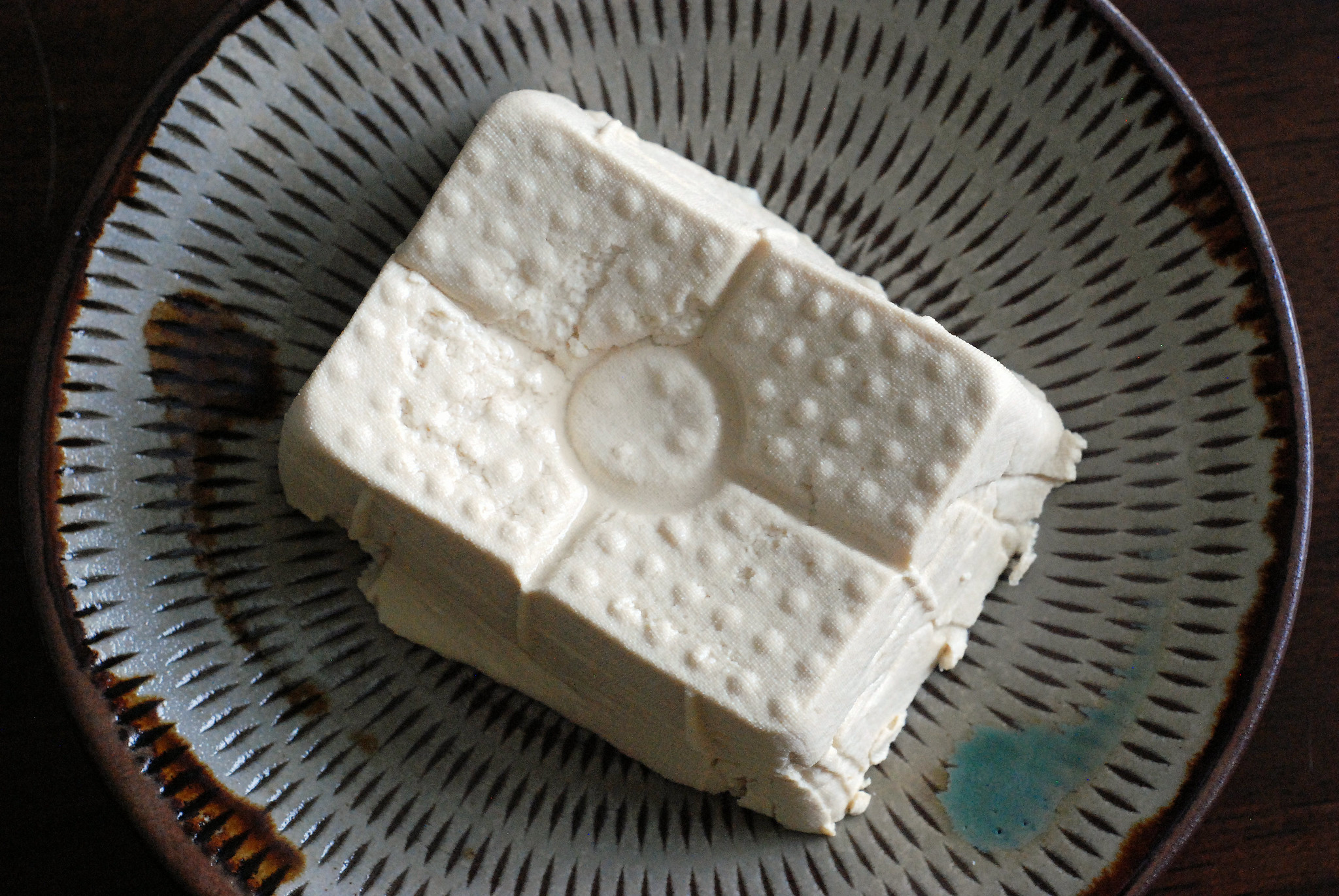
Fresh tofu

Fresh off the presses

We used about a quart of soy milk fresh from the soy milk maker, and it took 5 tablespoons of brine to make it coagulate. That made about 8 oz of firm tofu.

Using vinegar resulted in a somewhat less creamy texture than nigari does, and there was only the slightest a hint of all those great Thai cherry pickle flavours from the brine. Conclusion: there doesn’t seem to be much point in using a complex vinegar, but vinegar does give a good result. Even if you can’t find nigari, you can still make better-than-supermarket tofu at home using vinegar. The planet will benefit from your efforts by having a little less plastic in its landfills, and a little less CO2 in its air – and one thing’s for certain: if you take the time to make your tofu from scratch, you won’t be throwing it away.

Tofu frying

Tofu in wok

We used this particular batch of tofu to make Pad Thai, which we served with a few pickled cherries on the side. We used seitan instead of shrimp, though the meal wasn’t 100% vegetarian thanks to a couple of tablespoons of fish sauce.

Pad Thai with pickled cherries

Pad Thai with spicy pickled cherries

222 million tons in LA Times

Yesterday this URL got more than its usual amount of exercise thanks to an article in the LA Times: New app builds on efforts to reduce food waste. Most food waste articles focus on the magnitude of the problem, so it was particularly nice to be featured in a piece that was looking at what people are doing to make things better, including some who are already making a huge difference like EcoScraps and Food Cowboy.

It was my first interview, so I didn’t quite say everything I wanted to say the way I wanted to say it, but hopefully I’ll get other opportunities to bring attention to the food waste issue and things we can all do to make a difference.

Self-sufficiency in Surbiton

1975 was the year the Jefferson’s moved on up, the year Baretta and (more significantly for me) his parrot found their way onto the airwaves, the year that Anne Romano moved to Indianapolis with her two daughters, and the year that we saw a horrifying vision of what space uniforms might look like in Space 1999. At the time, I’m pretty sure I could have told you when each of those shows was on the air – and, I went out of my way to be staring at my TV set whenever they were.

Somehow, these stories seemed important.

A mere four decades (or so) later, somehow they don’t. I don’t even think I could muster the curiosity to watch a whole episode of any one of them. But there is one series that started airing in 1975 that I find myself watching every couple of years: The Good Life (which, if you’re from the US, and watched PBS, you might know as Good Neighbors).

The Good LifeIt was a charming, witty show about a couple that decides to opt out of the rat race, and become self-sufficient. The series follows them as they turn their home in a residential neighbourhood into a small farm, much to the dismay of their dear friends and neighbours. There are no special effects, no impossibly beautiful people, no murders, no perfect NY apartments, no space ships, and no parrots … but there are pigs and chickens, not to mention great chemistry between the characters.

More significantly, almost 40 years later, the show seems even more relevant than it was then – and Tom & Barbara’s determination, passion and values are worth emulating (not something that can be said of many TV couples).

If you’ve never seen The Good Life before, there are far worse things to spend money on on Amazon. The scene below is from the first episode…

Supermarket periphery cereal

I’ve always been a big fan of cereal – and as a kid, there was no cereal I liked better than Cap’n Crunch’s Crunch Berries™. Now don’t get me wrong; I’m not talking about these newfangled GMO blue, green and purple crunch berries. I’m talking about the original red ones – the ones that grow on crunch berry trees, and are coveted by the likes of the infamous Jean LaFoote – natural crunch berries, that grow wild. Man I loved those berries … the way they stained the milk pink … the way they kind of cut the roof of my mouth.

The great tragedy for us Canadian kids was that crunch berries were only available for a brief period – just long enough for us to fall in love with their subtle charms. Then they simply disappeared. It was a dark time.

We kids knew they still existed just south of the border, as we could see ads for the cereal on US channels, taunting us through a translucent veneer of white noise. But, for whatever reason – perhaps an embargo on the import of tropical fruit – they couldn’t cross the 49th parallel.

Fortunately, I had family in Massachusetts that I stayed with for a few weeks every summer. A highlight of those trips was always heading to a US supermarket – a magical place with an entire aisle of brightly coloured, plastic-toy-laden cereal boxes. Fortified with niacin. I was always allowed to choose a box of my favourite, and that favourite was always Cap’n Crunch’s Crunch Berries™.

Funny thing: now that I live in the US, I never even walk down that aisle. Aisles are where the processed food lives. The packaging alone represents a level of waste that is hard to justify – never mind the fact that it often involves multiple stages of processing and transportation, and the waste associated with the creation and use of additives and preservatives that humans can easily live without.

But, damn it, I still love cereal.

Fortunately, I married Bonnie Lee .. and, fortunately, a few months after we got married, she made her first batch of granola. It gave the milk a lovely brown tinge and caramel tone, had a satisfying crunch, and best of all was made with ingredients we could find in bulk at the edges of the supermarket (plus oil and honey). When I had my first bite, I knew it was love.

Granola has been a staple in our home ever since (except when we were in Japan, and had an oven the size of the bottom third of a shoebox). The recipe is never the same twice, so we don’t get bored, and it keeps well in the fridge. The recipe for Bonnie Lee’s latest batch is below.

July’s batch of granola

Granola

Ingredients

  • 4 cups rolled oats
  • 1½ cups shredded coconut
  • ½ cup sliced almonds
  • ½ cup flax
  • 1 cup pumpkin seeds
  • ¾ cups vegetable oil℉
  • ¾ cups honey
  • 1 cup dried cherries
  • 1 cup dried cranberries
  • ½ cup raisins

Directions

  • Preheat oven to 300℉.
  • Place rolled oats, shredded coconut, and sliced almonds in the largest glass baking dish you have.
  • Place the baking dish in the oven, and toast the ingredients for 15 minutes, stirring them every 5 minutes so that they toast evenly.
  • Remove the baking dish from the oven, and increase the temperature to 375℉.
  • Mix the flax and pumpkin seeds in with the toasted ingredients.
  • Heat the oil and honey over low heat or a microwave. The goal here is just to make the mixture a little less viscous, so that it blends well.
  • Stir the honey and oil mixture into the dry ingredients, until they are evenly coated.
  • Return the baking dish to the oven, and bake until the granola is nicely browned (about an hour), stirring it every fifteen minutes or so.
  • Remove the granola from the oven, pack it down, and let it cool.
  • Break the granola into chunks, and add in the dried fruit.
  • Store in the refrigerator in a sealed container.
Granola & Thai pickled cherries

Granola & Thai pickled cherries – probably not so great when eaten together.

Thai tofu cakes – attempt #1

We never finish a block of tofu in one meal, so often have a bit of frozen tofu on hand. As I mentioned in a previous post, tofu keeps well in the freezer – and after you thaw it, squeeze the water out of it, and crumble it, you’re left with a chewy, porous protein that absorbs flavors well.

One thing I’ve been meaning to try with it for a while is something similar to Thai fish cakes, and I made my first attempt at that this weekend.

The result was a bit too bready, and the flavors were less strong than I like them, so this recipe isn’t quite ready for company yet – but it did make for a tasty, hearty lunch, and went well with sliced cucumber (tossed in rice vinegar, honey, red pepper & cilantro dressing with a pinch of salt).

Thai tofu cakes - attempt #1

Thai tofu cakes (serves 2)

 Ingredients

  • 8 oz tofu, frozen, thawed, squeezed then crumbled (see image below)
  • 1 Tbsp fish sauce (or soy sauce)
  • 2 Tbsp grated ginger
  • 1 tsp red curry paste
  • 2 Tbsp cilantro, finely chopped
  • 1 Serrano pepper, seeded and finely chopped
  • 1 scallion, finely sliced
  • 2 eggs, lightly beaten
  • About 12 Tbsp panko or fine breadcrumbs
  • 2 Tbsp cooking oil
  • 1 lime
  • 4 Tbsp Thai sweet chili sauce

Directions

  • Toss tofu with fish sauce, grated ginger, and red curry paste.
  • Add in the cilantro, Serrano pepper, scallion and eggs, and mix well.
  • Mix in the breadcrumbs, 1 tablespoon at a time, until the mixture is sticky enough to form patties.
  • Make 4 patties, and place them in the fridge for 10 minutes, to allow them to set.
  • Heat oil in a skillet over medium heat.
  • Cook patties until they are golden brown – about three minutes per side.
  • Serve hot, with Thai sweet chili sauce.
Tofu: frozen, thawed, squeezed and crumbled

Tofu: frozen, thawed, squeezed and crumbled

Rescued mushroom risotto

A few months back, I wrote an entry on stone soup, which suggested that people freeze vegetable peels and bits that they would normally compost or throw away, and then use them to make stock. If you followed that advice, you will have noticed by now that you generate a fair amount of stock. We end up making about 8 cups of it a week.

This week, I found myself with about six cups of stock to use up, and was in the mood for something heartier than soup. We also had a few oyster and porcini mushrooms that were drying up in the vegetable crisper – all of which added up to the perfect excuse to make a white wine and mushroom risotto.

I started by rehydrating the mushrooms in white wine, which not only made the mushrooms nice and plump, but also gave me a rich-coloured mushroomy liquid to start the risotto with. (Bonus! That wouldn’t happen with fresh mushrooms.) That, plus a stone soup broth that had strong corn, beet and celery notes made for a dish with a complex palette of flavours and a creamy texture. Not bad, considering that the slightly shriveled mushrooms and stock ingredients were all things that would have ended up in the bin in many homes.

Of course, we ended up with more risotto than we could eat in one sitting – but the leftovers made for very good risotto cakes.

One thing I should mention is that making risotto the old-fashioned way takes time (about 45 minutes) and much that time is spent stirring. If you don’t have time for that, you can make it in a rice cooker with a lot less fuss (there are a few recipes on-line). I’ve tried that, and the result was quite good, though not as good.

Mushroom risotto

Rescued mushroom risotto, served with faux meat balls & salad

Rescued mushroom risotto (serves 6)

Ingredients

  • ½ cup dried mushrooms
  • 1 cup dry white wine
  • 6 cups stone soup (or other) stock
  • 2 tbsp butter
  • 2 tbsp olive oil
  • ½ large onion, sliced thin
  • 1 clove garlic, crushed
  • 1½ cups Arborio rice
  • ¼ cup grated parmesan
  • Salt and pepper to taste

 Directions

  • Cover mushrooms in wine, and allow to reconstitute. This can take up to 30 minutes, depending on how dry the mushrooms were to begin with.
  • While the mushrooms are reconstituting, heat your stock in a deep skillet, and keep it warm over medium low heat.
  • When the mushrooms are reconstituted, set the liquid aside for later use. Sauté the mushrooms in 1 tablespoon of the olive oil until they are tender – then set those aside for later use.
  • Heat 1 tablespoon of butter and one tablespoon of oil in a skillet over medium heat, then toss in the sliced onion and crushed garlic, and sauté until the onion is translucent.
  • Add in the Arborio rice, and sauté for an additional 2 minutes.
  • Add in the liquid from the mushrooms, and stir until it the liquid absorbed.
  • Add in the warm soup stock, one ladleful at a time, and stir until the liquid is absorbed. When you’ve used up about ¾ of the stock, add in the mushrooms, and keep going. After each ladleful is absorbed, you should taste the risotto. When the the rice is al dente, and the sauce is creamy, it will be done. You may need a little less stock than indicated, or a little more. If you need more, and have run out, just use water that has been boiled and is still warm.
  • When the risotto is done, stir in one tablespoon of butter, the parmesan cheese and salt and pepper to taste.
  • Serve immediately.
Fun facts
Amount of shriveled mushrooms saved from landfill per six portions of rescued mushroom risotto. 1/4 cup
Approximate volume of shriveled mushrooms that could be saved from landfill every year if everyone in the US had 4 servings of rescued mushroom risotto a year. 12,000 cubic meters
Approximate volume of the Tower of Pisa. 10,000 cubic meters

A pig with a problem

The video below is the tale of a wee, sad pig with a nasty addiction, along with some of his reflections on life and food waste … the product of me spending way too much time on long flights and alone in hotel rooms, I suspect.

Warning: in addition to being a gripping yarn, the video is plug for the 222 million tons blog & our iPad meal planning app … though, after this entry, we’ll return to our regular programming: things to do with stone soup broth & veg that is on it’s way out, vermicompost updates, etc.

222 million tons: the App

The idea behind 222 million tons has always been to spark conversation and change – and to do that by sharing tips, tools, and resources that help people waste less food and eat well. So far, that’s only been through this blog, but as of last week, we have an iPad App in iTunes.

The App is a publishing platform for weekly menus and shopping lists. The recipes all work for a single person (though through the miracle of technology, they can be scaled), and use up all the fresh ingredients on the shopping lists.

The idea was Bonnie Lee’s, and emerged out of her frustration over the amount of food she was wasting when she first moved from Tokyo to Los Angeles. She was overwhelmed by the quantities that food was sold in, and had no idea how a single person could use it all before it spoiled. In Japan, there are home economics magazines that help people save money by providing weekly shopping lists and recipes, but she couldn’t find anything like that in L.A. – and all the recipes she could find served 6 to 12 people. Bonnie Lee doesn’t like leftovers … so she issued me a challenge, which led to this App, built by our friends & partners at bluejava: Glenn & Makiko.

The first collection of recipes is called Bright & Bold, and was written by me (more on that another day), but my hope is that the 222 millions tons App will become a platform on which a large community of home cooks shares recipes – and if anyone reading this is interested in becoming part of that community, let me know via the comments below, or through any of the community platforms listed on my Gravatar profile.

The key to reducing food waste at home is planning – and as I wrote Bright & Bold, I came to appreciate the challenge of planning whole weeks for a single person with both variety and zero waste. So, if you don’t have time to plan meals, but hate waste and like to eat well … well, now there’s an App that can help.

Dry vegetable curry with cauliflower leaves & stems

One way to minimize waste is to have a few go-to recipes for the unused odds and bits that accumulate in the vegetable crisper. One of mine is dry vegetable curry. It’s a quick and tasty way to cook up whatever vegetables you have on hand.

This past the weekend I made some roasted cauliflower florets, which meant that I had a cauliflower stem and some cauliflower leaves to use up – and those made up the bulk of my most recent dry curry. I also threw in a couple of carrots, mushrooms, and plum tomatoes, as well as a few green beans and part of an onion.

In case you’ve spent your life blithely throwing away cauliflower stems and leaves, let me just point out a few things:

  • Cauliflower stems and leaves are food.
  • My most recent cauliflower weighed about 2 lbs 9 oz, and of that 9 ounces was made up of stem and leaves. That’s 22% of the cauliflower. If you’ve spent your life throwing these parts away (and if we use that 22% as an average), then for every 9 cauliflowers you’ve ever bought, you’ve thrown away 2 cauliflowers worth of perfectly usable food that you paid for. You probably don’t do this with donuts. Or socks.
  • Cauliflower stems may be less pretty than florets, but they taste similar, and are very tender. I usually just cut the big central stem in half, then cut those halves into slices.
  • Cauliflower leaves are very tender and thin at the tips, and cook up like any leafy green. Near the base, the leaves are more like cabbage, but more watery (which balances hot spices nicely) and not as tough.

I served this week’s dry curry with some turmeric rice and watermelon rind chutney (which we’re close to running out of). Easy. Tasty.

Dry vegetable curry (for 1)

Dry vegetable curry

Ingredients

  • Enough oil to grease your skillet
  • 1 cup mixed chopped vegetables
  • 1 tsp crushed garlic
  • 1 tsp grated ginger
  • 1 Tbsp tamarind paste (or 1 tsp lemon juice)
  • 1 tsp cider vinegar
  • ¾ tsp dry curry mix (see below)

Dry curry mix (these days)

  • 2 parts cumin
  • 2 parts paprika
  • 2 parts turmeric
  • 2 parts mustard powder
  • 1 part garam masala
  • 1 part cayenne pepper (or to taste)
  • 1 part cinnamon
  • 1 part brown sugar
  • 1 part salt (or to taste)

Directions

Sauté the vegetables over medium heat in oil until just shy of desired tenderness. OK, this is vague, but the timing depends on the vegetables you use, the size you cut them, and how tender you like them. Also, you’ll want to add things that take longer to cook a little earlier. I like my vegetables crunchy, so this step usually takes me 4 or 5 minutes.

Add in the garlic and ginger, and sauté for an additional 30 seconds.

Add in the tamarind paste (or lemon), vinegar, and dry curry spice mix, and stir until vegetables are coated.

Serve.

Fun facts
Annual per capita demand for cauliflower in the US 1.7 lbs
Total annual demand for cauliflower in the US 264,853 short tons
Unnecessary food waste created if no one in the US eats cauliflower stems & leaves (assuming they represent 22% of mass of cauliflowers) 58,267 short tons
Equivalent number of 2lb 9oz cauliflowers 45,476,682
Cargo mass of a Boeing 747-8F 295,800 lbs
Minimum number of Boeing 747-8Fs needed carry all that waste 394

Fuzz is for peaches

One 20 hour flight later, I’m back in LA (for a little while anyway) – and one of the first things we did when I returned was head to the farmers’ market in Torrance. I figured a little sunshine and fresh food would help me forget my jet lag.

I was wrong.

We didn’t do much shopping in the end, though we did pick up some stunning Seascape and Chandler strawberries – two varieties that are bursting with flavor, especially when they’re perfectly ripe (as these were), and bright red all the way to the center.

Seascape & Chandler strawberries

Our Seascape & Chandler strawberries, begging to be devoured

It seems that whenever we get strawberries at the local supermarket, we find one or two in the middle that are covered with fuzz – and the rest of the batch isn’t far behind. That’s why I’ve gotten in the habit of soaking berries in a vinegar and water solution for a couple of minutes before putting them in the fridge (I use about 3 cups of water and 4 tablespoons of water). That kills the beasties that lead to fuzz (and waste), and the berries generally keep for a couple of weeks after that. (It helps that supermarket berries are inevitably underripe.)

None of the berries from the farmers’ market had any fuzz, but I soaked them in a vinegar solution anyway – just to be safe. I needn’t have bothered, as they only escaped being eaten for a couple of days. The few that weren’t eaten immediately, ended up in strawberry rhubarb crisp.

Strawberry rhubarb crisp (serves 2)

Ingredients

  • ½ cup cut strawberries
  • ½ cup cut rhubarb
  • 1 Tbsp +1 tsp brown sugar
  • 1 Tbsp butter
  • 1 Tbsp flour
  • 1 Tbsp rolled oats

Directions

Preheat your oven to 375℉, and grease a baking dish with butter or cooking spray (you can do the planet a favor and make your own cooking spray with oil and a spray bottle). You want the fruit to be about an inch to and inch and a half deep – for this quantity, a round dish with a 5¾ inch diameter did the trick.

Toss the cut strawberries and rhubarb with 1 teaspoon of the brown sugar, then place it in your greased baking dish.

Melt the butter and stir in the flour, rolled oats and remaining sugar – then crumble the mixture on top of the fruit.

Bake at 375℉ for 45 minutes, then enjoy while it’s still hot.