CoolCalifornia.org provides resources that help Californians reduce their environmental impact and take action to stop climate change … and is a client of Bonnie Lee’s. If you happen to be in L.A. the evening of May 17, this may be of interest.
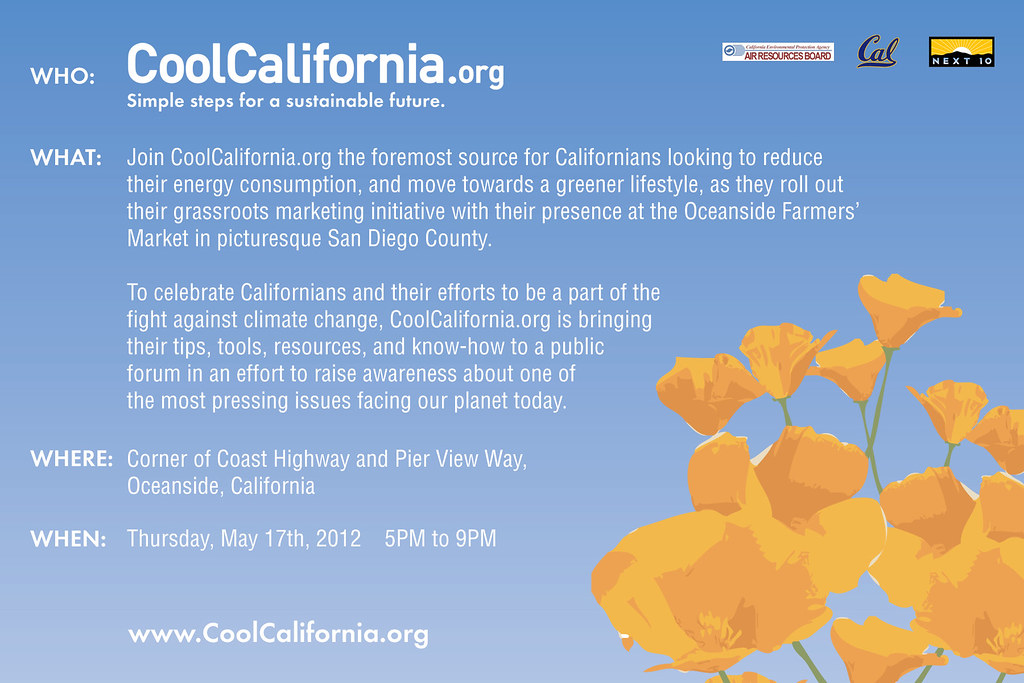

CoolCalifornia.org provides resources that help Californians reduce their environmental impact and take action to stop climate change … and is a client of Bonnie Lee’s. If you happen to be in L.A. the evening of May 17, this may be of interest.
Once upon a time, I worked for a company called IBM, and lived in a city called Tokyo. One of my roles there was to drive the adoption of social media (inside the firewall). I spent a whole lot of time thinking about, observing and participating in online conversations – and came to see the value of them as this: you learn. And that’s the main reason I started this blog in January.
I was passionate about the issue of food waste, though I only had a little bit to say about it – maybe enough material for an entry or five. But I knew that through the act of writing, I would come to think more deeply about the subject, and start to connect with people who would push me in new directions. I was excited at the prospect of finding those people, and those directions.
 Two of those people turned out to be Shannon, who writes dirt n kids, and Nicole Brait, who writes The Sustain Blog – both of whom recently received nominations for the Kreativ Blogger Award and the Versatile Blogger Award, for obvious reasons. Shannon writes with humor and warmth about the things she’s passionate about (dirt & kids). She also manages to raise 4 kids without generating more than a small bag of trash a week. Nicole writes about a variety of sustainability topics, and has made me consider things I would never have thought of, like raising bees (although we have no yard, which I guess is a show stopper).
 So, what do these awards mean? Well, for one thing, they give you the opportunity to highlight a few blogs you like, and nominate them for an award. Both Shannon and Nicole included 222 million tons on their lists of nominees. Many thanks to them both for that [insert acceptance speech here], and now it’s my turn to highlight a few blogs that I enjoy:
All of these are ones I check out regularly (though there are many more). Some have been nominated before, but I just wanted to highlight them here for those with similar interests. And some would not consider Grist a blog per se, but it is built on WordPress, so I decided it could be included.
As a nominee, I am also meant to share 7 fun facts about myself, so here goes:

The bosses
About a month ago, I wrote an entry on what I call stone soup. The recipe in that entry is simple:
…whenever I peel or chop vegetables or meats, I toss any bits that would usually be destined for the compost or garbage bin into a colander, wash them, then put them in a container in the freezer. When I want to make stock, I throw the stone-like frozen scraps into water and boil.
As one friend noted, though, “Ive started my stone soup freezer bag! Once you start, it grows quickly!” Very quickly – and the challenge is to find varied ways to use up all that stock (we end up making about 8 cups of it every weekend). Last week, I did something based on this great dahl recipe from Wolfgang Puck, and it’s definitely a keeper.

For the version I made, I used brown lentils, rather than orange ones – and stone soup stock rather than chicken stock. The stock that week was made with a healthy amount of beet peelings, and was dark colored with earthy tones, which worked perfectly in this recipe. I served the dahl with some homemade dosa (a rice and lentil batter pancake), kale salad, a spicy coleslaw, and some watermelon rind chutney – a satisfying, warming meal.
One thing to note: unless you’re catering a wedding, I suggest that you make about a quarter of the recipe at the link. That makes about 4 normal sized servings.
The Hanging Gardens of Babylon are usually listed amongst the seven wonders of the ancient world – yet as far as gardens go, they were missing one thing that would have made them even better: strawberries, a fruit that would not land on the shores of the old world for another couple of thousand years. It was a sad berriless time in human history, unless you lived in the Americas.

I’m a huge fan of strawberries (maybe you guessed that), and, as a kid, I used to surgically remove their leaves (calyxes) to ensure that not one molecule of that sweet red flesh went to waste. I must confess, I’ve gotten sloppier as I’ve gotten older – but I don’t feel good about that. So, I recently started to wonder about strawberry tops, and what I could do with them.
It turns out that many people use them in smoothies, or to make tea. One word of caution, though: the leaves of strawberry plants release hydrogen cyanide gas as they decay – and that’s not so good for you. So, if you want to use strawberry leaves, you either need to use them before they start to wilt, or after they’ve had time to dry out.
After I made strawberry pancakes yesterday, I was left with a half dozen strawberry tops. Rather than waste them, I seeped them in hot water, and ended up with a light pink, fruity herbal tea.
And after I was done soaking all the goodness out of the strawberries, the worms in the composter got a delicious snack that would have been the envy of His Royal Highness, King Nebuchadnezzar II. They seemed happy.
In Japan, we were spoiled. There was a tofu shop a short walk from our apartment, where the tofu was made daily. You had to go early to get what you wanted, because the shop closed once they’d sold what they made that day. And you had to get there particularly early to get the silken tofu, which was rich, creamy and velvety; with a little bit of soy and ginger, this stuff was decadent. It was best eaten fresh, and there were never any leftovers.

Japanese silken tofu
Outside of Japan (and that includes the rest of Asia), tofu is a completely different food; it’s good, but doesn’t feel like an indulgence. It’s also not a food that stands up on it’s own, so we tend to marinate it and mix it with other ingredients. For one meal, we only need half of a firm 12 oz block – which means that half needs to be stored. If I plan to use the other half in the next couple of days, I just keep it in the fridge, submerged in water. More often than not, though, I just freeze it.
Firm tofu holds up well to freezing – and I actually prefer the texture North American tofu has after having been frozen. It chewier. It’s also more porous, and absorbs other flavors well.

Before freezing their tofu, some people squeeze the water out. I don’t bother. I just pop it into the freezer (in a baggie) where it turns a lovely shade of yellow. I take it out of the freezer several hours before I plan on using it, and let it thaw in the fridge or on the counter. After it thaws, I squeeze the water out of it, crumble it, then get cooking.
For the dish below, I tossed the crumbled tofu in a bit of cooking oil, with a few drops of Worcestershire sauce, some chipotle powder, salt and pepper. I sautéed it with onions, garlic and diced red jalapeño, then served it on a warmed tortilla over melted cheese, along with avocado (tossed in lime juice), sour cream, and a hot salsa. Quick, easy and satisfying.

Tofu taco
Be you a vegan, vegetarian, locavore, raw food advocate, fructarian, slow food advocate or, well, whatever … this is well worth a read.
Mixed green fritters are a great way to enjoy edible greens – both the ones that people traditionally eat (like kale, mustard greens and spinach), and the ones that people usually throw away (like those of sweet potatoes, radishes, beets and broccoli).

I made my most recent batch using a simple and healthier-than-deep-fried recipe from food to glow that I had been meaning to try. (Food to glow is a great food blog focused on nutrition and cancer.) The original recipe was made with foraged greens – but rather than go foraging around LAX, I decided to use what I could forage from my fridge: beet greens, kale (with stems removed), cilantro and scallions.
The cilantro, scallions and beet green stems elevated what would have been a very nice side dish to a more central role in the meal, and were nicely complemented by a dollop of chipotle mayonnaise.

A few ideas on how to avoid food waste from grist.org
The food waste infographic below was created by Door to Door Organics (a company that delivers organic vegetables). It highlights the fact that food waste isn’t just about wasting food; it’s about wasting the water, oil and land that went into producing that food. The sheer volume of that waste is staggering – and we can all do a little something about it: plan better.

You can see the original blog entry in which this was published by clicking on the image.
A hungry traveller arrives in a village, and asks the people there if they have any food to share. They all say no. It is an all too common a story.
This particular traveller, however, does not leave the village defeated and hungry. He does not go on to die by the side of the road – though countless others in his situation certainly have. Instead, he fills a pot with water, pulls a stone out of his travel bag and drops it in, and places the pot on the fire.
One by one, the villagers come to him, and ask him what he is doing. He explains that this is a soup stone, and that he making stone soup, which he would be happy to share – and which would be even better with the addition of some small ingredient.
The villagers, who not so long ago claimed to have nothing, each add a little something to the stone broth, eventually creating a feast together – one which they share.
In case you never heard it before, the above is a boiled down version of the story of stone soup. I can still remember the first time my mother read it to me. Something about it moved me. The traveller was cunning, and the moral of the story resonated – but more significantly, I was amazed that that’s all there was to soup. I quizzed my mother to make sure I understood properly – that all you had to do to make soup was boil stuff. I was three or four years old, and am quite sure I’d never thought about where soup came from before. Soup, to me, was a rich flavored liquid, origins unknown, that warmed and satisfied on a cold day. And all you had to do to make it was boil stuff. That felt like magic to me.
All these years later, the ability to extract the essence of foods, and to combine them into complex, layered flavors still feels like magic. For years, I started with whole vegetables and chickens, but have had better results lately using food that used to go straight into the compost or garbage.
 What I do is this: whenever I peel or chop vegetables or meats, I toss any bits that would usually be destined for the compost or garbage bin into a colander, wash them, then put them in a container in the freezer. When I want to make stock, I throw the stone-like frozen scraps into water and boil. I made the last batch with corn cobs, chicken wing tips, carrot greens, onion skins, celery and carrots ends, carrot peels and some cauliflower leaves and carrot tops that didn’t make it onto the menu a few weeks ago. It was complex with a hint of sweetness – and, in the spirit of stone soup, it was a broth made in what some would perceive as the absence of food.
I used three cups “stone soup” broth to make one of my favorite soups – a spicy beer and cheddar soup. The final product really benefitted from the multitude of flavors in the broth, particularly the distinctive flavor of corn imparted by the corn cobs.
Spicy beer & cheddar soup (serves 4)

Directions
 222 million tons